Imagine chatting with a super-smart robot that can write stories or answer questions almost like a human. This is what generative AI (like Chat-GPT or other Large Language Models) does – it generates responses by learning from lots of text. But just as humans can make mistakes or say inappropriate things, AI models can too. How do we test that an AI is doing a good job (and not messing up)? And how do we guide or restrict an AI so it doesn’t do anything dangerous or harmful? In this blog, we’ll explore these ideas in simple terms, using analogies from everyday life – like school exams, driving rules, or keeping secrets – to explain how we evaluate AIs and set up guardrails to keep them safe and helpful.
Think of an LLM as a super‑powered autocomplete trained on tons of text. It predicts what comes next to form answers. It sounds smart—but it doesn’t truly “understand” like a human, so we must test it and set boundaries.
What Are Evals? (AI’s Exams)
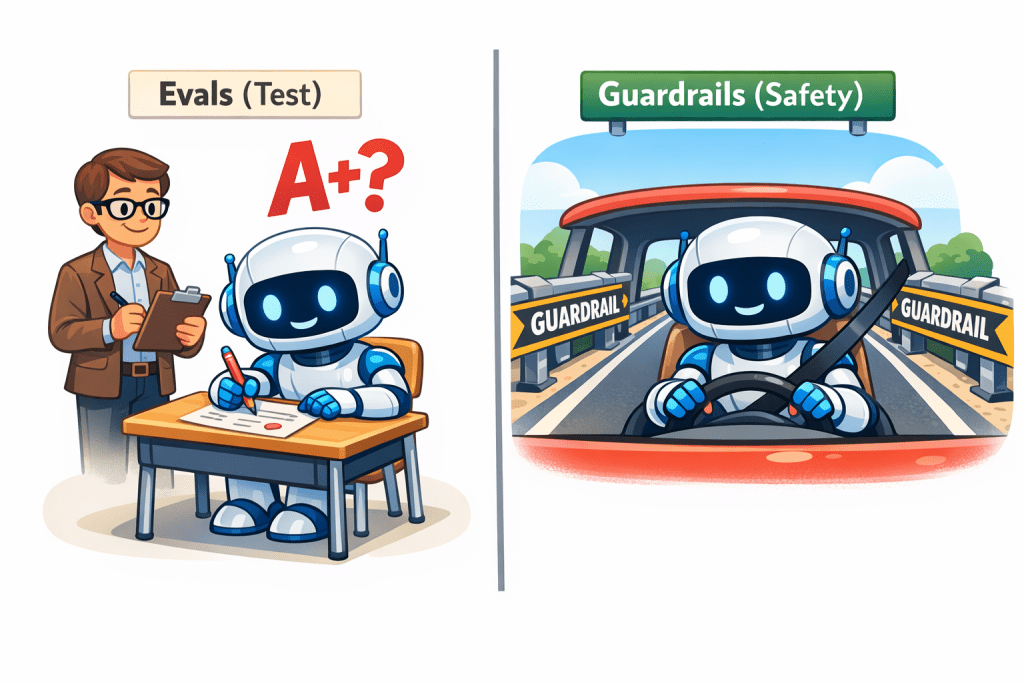
Evals are tests that measure how well an AI performs—like school exams.
Why evals matter:
Because they tell us if the AI is actually working well and where it might be failing. If an AI was a student, evals would be its report card. A straight-A report card means it’s doing great; a report card with some Cs or Ds means it needs improvement in those areas. With AIs, evals help developers understand if the model is “smart” in the way we want: Does it give accurate facts? Is it following instructions? Is it being fair or does it have biases? If the evals show problems, developers can go back and fine-tune the AI or fix issues.
Common eval types:
- Automated tests (quantitative): Check answers against known correct results (great for math, facts).
- Human review (qualitative): People grade open‑ended outputs (tone, clarity, usefulness).
- AI judges: Another model scores responses for speed and scale.
- Live monitoring: Track real‑world performance (user feedback, error rates).
example: if you write an essay for class, your teacher grading it and giving feedback is like an eval for your writing ability. In the same way, we “grade” an AI’s responses to make sure it’s up to par.
Guardrails: Keeping AI Behaviors in Check (Like Safety Rules)
What are “guardrails”? If evals are tests after the fact, guardrails are preventative measures we put in place from the start to help the AI avoid wrong turns. The term “guardrail” comes from those safety railings on highways – they don’t drive the car for you, but if you start drifting off the road, guardrails keep you from going over the edge. In AI, guardrails are like rules or filters that guide the AI’s behavior in real time so it doesn’t produce something harmful, inappropriate, or dangerously incorrect.
Guardrails can include things like:
- Content filters: e.g. a rule that says “if the user asks for something obviously dangerous or disallowed, refuse politely.” For example, an AI might be instructed never to provide instructions for illegal activities or never to use hate speech.
- Format or logic checks: e.g. if the AI is supposed to output in JSON format or in a specific style, a guardrail might catch if the output is not in that format and fix it or stop it.
- Policies and guidelines baked in: The AI can have guidelines from its creators (like OpenAI’s usage policies) that act as internal guardrails to prevent it from generating certain types of content.
Why do we need guardrails? Because AIs, especially powerful ones, could potentially generate content that is problematic – like made-up facts (“hallucinations”), offensive language, or even dangerous advice. We want the AI to stay “in bounds,” kind of like making sure a self-driving car stays in its lane. Guardrails greatly reduce risks by catching bad outputs before they reach the user.
Evals vs Guardrails (How They Work Together)
- Evals = measure quality (after or during development).
- Guardrails = enforce safety (during every interaction).
You need both: tests to improve, and rules to prevent harm.
Key Evaluation Metrics for Text Generation
| Metric Name | What It Measures | Typical Use Cases | Pros (Strengths) | Cons (Limitations) |
|---|---|---|---|---|
| BLEU (n-gram overlap precision) | Word overlap vs. reference text (precision of matching n-grams). Essentially, how much of the model output’s wording appears in the reference. | Machine translation; also summarization or captioning tasks with reference outputs. | Widely used & easy to compute; good for checking content alignment; objective numeric comparison. | Misses meaning beyond exact matches (no credit for paraphrase/synonyms); low correlation with human quality on free-form tasks. |
| ROUGE (n-gram overlap recall) | Content recall vs. reference (how much of the reference’s content is present in output). Emphasizes capturing key points. | Summarization quality; also used in translation eval. | Emphasizes coverage of important info (useful for summaries); fast to compute; standard in summarization research. | Similar to BLEU, insensitive to rewording; can encourage verbose outputs to hit recall; not reliable alone for judging semantic quality. |
| METEOR (unigram precision/recall with synonyms) | Flexible overlap vs. reference, considering synonyms/stems & word order. More nuanced matching than BLEU/ROUGE. | Translation & captioning eval (especially where slight wording differences are okay). | Accounts for synonyms and morphology (more human-like matching); historically higher correlation with human judgment than BLEU. | More complex (needs language-specific resources); still not perfect on meaning (if synonyms database misses something). |
| BERTScore (embedding similarity) | Semantic similarity between output & reference using contextual embeddings (scores like precision/recall of meaning). | Any text gen with references: summarization, MT, etc. Especially for free-form outputs where strict overlap is too harsh. | Captures meaning better than lexical metrics (scores synonyms, phrasing differences as similar); often aligns better with human preference than BLEU on many tasks. | Depends on the embedding model’s quality (may not work well for domain-specific content); less interpretable; doesn’t detect factual errors if they still sound semantically alike. |
| Perplexity (intrinsic LM fit) | Fluency / predicted likelihood of text. Lower perplexity = model finds the text more predictable (better fit). | Language model training eval; measuring general model improvements (not tied to a specific prompt-answer task). | Direct measure of LM’s training quality; good for comparing models or tracking progress (a lower PPL generally means a more fluent model). | Not task-specific or user-facing; doesn’t guarantee correctness or relevance in responses; only defined for models that output probabilities. |
| Exact Match (Accuracy) | Strict correctness: did the output exactly match the expected answer (after normalization)? | QA (e.g., SQuAD), fill-in-the-blank tasks, or classification where one right answer exists. | Clear and binary – easy to interpret; directly reflects fully correct answers. | Too rigid for varied phrasing or partial answers (no partial credit); not meaningful if multiple valid answers. |
| F1 Score (for QA/Extraction) | Partial correctness: overlap of output vs. reference answer in terms of precision & recall of tokens. Gives credit for partially correct answers. | QA metrics (often reported alongside EM); info extraction tasks. | Rewards partial matches, so more forgiving and informative than pure accuracy (captures if model got most of the answer). | Still based on lexical overlap; doesn’t account for synonyms unless exact; not useful for long-form or generative tasks beyond short answers. |
| Task Success (Pass@k, etc.) | Outcome success on a specific task. E.g., for code: did the generated code pass tests? For dialogue: did it achieve the goal? | Code generation (functional correctness); planning/agent tasks; multi-turn dialogues with defined success criteria. | Direct measure of real goal achievement (the model did what it was supposed to). Very meaningful for user-facing tasks (e.g., solving a problem). | Narrow – can only be used when an automated check of success exists (e.g. test cases, known solution); not applicable to open conversation quality. |
| Toxicity / Safety Score | Harmful content level (usually via classifier). E.g., probability text is toxic, or % of outputs flagged. | Chatbots & gen AI deployed publicly – track toxicity, bias, guideline violations. | Crucial for trust and compliance; can automatically scan lots of text for red flags. Helps compare models for safety improvements (lower toxic %). | Imperfect detectors (false positives/negatives); covers explicit issues but not subtle harmful implications; requires updates as definitions evolve. |
| Human Preference Score | User satisfaction or quality as judged by humans. E.g., % preference for model A over B in head-to-head outputs, or average rating on a scale. | Chatbot/assistant quality; any open-ended generation (often used in research and RLHF to fine-tune models with human feedback). | Directly reflects human judgments of helpfulness/correctness. Captures nuance that automated metrics miss; ensures the model optimizes for what people value. | Costly & slow (requires human labor); results can be inconsistent (different people may score differently). If using AI (LLM) as judge, it’s faster but introduces potential biases. |
 Curious Circuits